
From Bench to Breakthroughs: Nourhan Abdelfattah’s Journey in Cancer Research
Alum Spotlight | UT San Antonio Graduate School of Biomedical Sciences
Name: Nourhan Abdelfattah
Degree/Program: PhD, Cancer Biology Track (formerly IMGP, now IBMS)
Class Year: 2018
Current Role: Instructor, Houston Methodist Academic Institute
1. You were a student in Dr. Manjeet Rao’s lab and graduated in 2018. Can you tell us a little about your journey since graduating?
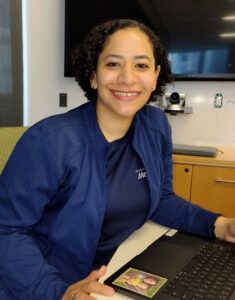
It’s been a deeply rewarding, yet challenging, journey. Transitioning from being a graduate student to the “real world” is overwhelming. I always knew I wanted to stay in academia, but as an international student on an F1 visa, I was terrified of not securing a position. On top of that, my first first-author manuscript had just been submitted, and I had welcomed my daughter just two months prior. I felt like I might drown in a sea of more qualified candidates. I shared these fears with Dr. Oyajobi, who encouraged me to test the waters and apply for positions in Houston, where my husband was finishing his PhD. Around that time, a serendipitous moment changed everything. My desk at the GCCRI was right across from Dr. Manjeet Rao’s office. I was taking a break one day, and as I walked past, I overheard him on the phone excitedly saying, “She is the best you could ever ask for.” I didn’t know who he was talking about, but minutes later, I received a call from Dr. Kyuson Yun at Houston Methodist. We spoke for maybe two minutes before she told me she wanted to hire me as a postdoctoral fellow! I asked if I could do a proper interview and visit the lab first, which went incredibly well.
I earned my PhD in 2018, stayed a couple of months to submit my dissertation, and started my postdoc that May. My postdoctoral career has had its ups and downs, but I love my science and wouldn’t trade this path for anything.
2. Looking back, how did your experience in Dr. Manjeet Rao’s lab shape your scientific interests and career trajectory?
First and foremost, Dr. Rao is an amazing mentor who genuinely valued work-life balance. He created a welcoming lab environment, which made choosing him as a mentor an easy decision. Even as a young rotating student fresh out of undergrad, he listened to my input and valued my opinions, a stark contrast to others who had dismissed or talked over me. His support was so personal that his wife even hosted a surprise baby shower for me in their home when I was pregnant! I was an international student with no close family around me, yet I never felt alone.
Scientifically, his lab gave me a phenomenal foundation. My dissertation focused on identifying microRNA combinations that enhance the efficacy of radio- and chemotherapy while preserving normal brain cells. That work led to a patent and a first-author paper in Nature Communications.
3. You are now an Instructor at Houston Methodist. What is your current research focus and what questions are you most excited to explore?
My research explores the immune landscape of brain tumors, particularly medulloblastoma and glioblastoma, with a focus on immune evasion and therapeutic target discovery.
I use single-cell RNA sequencing, single-cell multiomics, and spatial transcriptomics to rapidly and accurately identify key immune interactions in the tumor microenvironment and their biological profiles.
Right now, I am highly focused on a sex-specific driver for immune evasion in brain tumors and neurodegenerative diseases. My current work demonstrates how pivotal it is to treat sex as a biological variable when designing clinical trials and treatment modalities.
4. Your recent publication in Cancer Cell is a major milestone. Can you share what the research discovered and why it is important for the field of oncology?
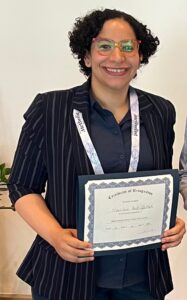 That paper represents seven long years of hard work. Our research identified a male-biased Yap1-Cd276/B7-H3 axis responsible for immune evasion in medulloblastoma. We discovered that the Yap1 oncogene functions differently in males versus females, adding a crucial layer of understanding to how these tumors operate and hide from the immune system.
This is highly important for oncology because understanding these sex-biased immune suppression mechanisms opens the door to much more targeted, personalized therapies. It proves that a “one-size-fits-all” approach to immunotherapy isn’t enough; we must account for sex-specific differences to treat this devastating disease effectively.
5. Reflecting on your time at UT Health San Antonio, what experiences or mentors had the greatest impact on your development as a scientist?
UT Health San Antonio has the absolute best student advocates on the planet. The Dean’s office, for instance, was incredible. Dr. Sophie Pina, a Vice Dean for Student Affairs at the time, personally drove me to the Social Security office during my first month in the US to get my card, and drove me back again to fix a typo they made with my name! Vice Dean Dr. Nicquet Blake and Dean Dr. Weiss were a constant support system from my interview to my graduation. They made me feel like I truly belonged, which motivated me to give back through the Graduate School Association and the Student Government Association.
That support became vital when my father passed away from cancer in Egypt during my first year. Initially, a professor told me that leaving to see him would mean repeating my cancer core class or potentially the whole year. I felt entirely helpless. But Dr. Rao, whom I was only rotating with at the time, immediately stepped in and went to Dr. Blake. She firmly stated they would do everything in their power to let me go. Tragically, my father passed away the same day I was cleared to leave. Dr. Rao called my husband in Houston to come be with me, and personally took care of my cell lines. When I returned, Dr. Oyajobi emailed me to ask if I was okay, and he hasn’t stopped checking in on me since. He told me he was proud of me for persevering and getting an ‘A’ in my core class despite it all. The mentorship at UTHSCSA goes far beyond science; they treat you like family.
6. What has been one of the most rewarding aspects of your career so far?
 Honestly, it’s been my ability to remain resilient and productive despite the very real challenges of life. Over the course of my postgraduate career, I’ve had some gaps due to personal and family health issues, maternity leave (I’m a proud mom of two!), and family losses. Yet, I was still able to build a unique dual-expertise in both wet-lab and computational biology, earn competitive funding like the DOD Horizon Award, and contribute to highly impactful science.
Beyond that, I just genuinely love what I do. It’s as simple as that—going to work isn’t a chore. I am a total data geek, and I get ecstatic when I make even the smallest discoveries. I absolutely love the look on a collaborator’s face when I show them their hard-earned data translated into beautiful, clear figures.
7. What advice would you give to current graduate students, particularly international students who hope to pursue scientific careers in the United States?
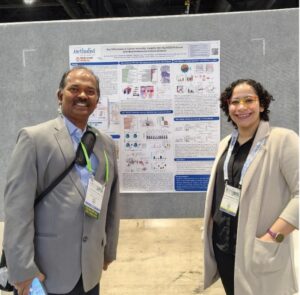 First, test the waters early! Don’t let visa anxiety stop you from applying for positions before your defense.
Second, absolutely do not give up when you face rejection. My Cancer Cell manuscript was initially submitted to Cancer Discovery. It went through review and was accepted by two reviewers, but was ultimately rejected because of the third. When I told Dr. Rao the news, I was devastated and afraid of disappointing him. But he simply said, “Don’t worry, it will find its home.” I held onto his words, and he was right. It found its home in an even better journal. Trust your science. Your failed experiments will one day work, and your manuscripts will find their home.
8. You have long spoken about the importance of mentorship in STEM. What message would you like to share with the next generation of scientists following in your path?
Mentorship is everything. The scientists and administrators who impacted me the most, like Dr. Rao, Dr. Yun, Dr. Oyajobi, and the leadership in the Dean’s office, didn’t just teach me how to run assays or analyze data. They advocated for me in rooms I wasn’t in, supported me when I became a mother, and held me up when I lost my father.
My message to the next generation is to seek out mentors who see you as a whole human being, not just a pair of hands at the bench. And as you advance in your own career, make sure you become that kind of fierce advocate for the trainees coming up behind you.


