

Scientists research a solution to the metabolic crisis

Scientists in Texas and Pennsylvania have identified a protein sensor that restricts how much sugar and fat our cells convert into energy during periods of starvation. It is possible, the scientists say, that the sensor could be fine-tuned to prompt more sugar and fat conversion in people with metabolic conditions such as diabetes, obesity and cardiovascular disease who need help trimming down and living a healthier lifestyle.
The study was published April 21 in the journal Science Signaling.
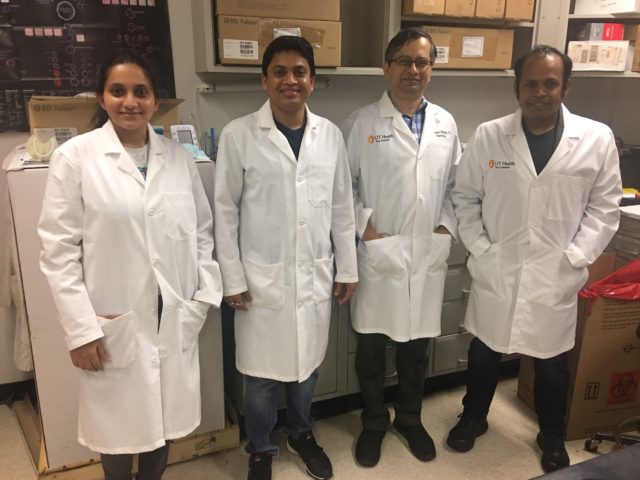
Senior author Madesh Muniswamy, Ph.D., from the Long School of Medicine at The University of Texas Health Science Center at San Antonio, is an expert in the function and properties of mitochondria. These are the cell structures that convert sugar and fat into chemical energy called ATP.
“We want to offer, in the future, a solution to the metabolic crisis faced by millions of people across the world,” Dr. Muniswamy said. “Millions of people consume too much food, while millions of others are in poverty and subsist on too little food. We are studying what happens at the molecular level in both situations with a goal of developing a drug to intervene.”
Speed of conversion
Our bodies continuously move things from cell to cell with what are sort of like roadways and cars. The vehicle required for fat and sugar conversion is called the mitochondrial calcium uniporter, or MCU. Like traffic moving people to destinations, the speed at which the MCU moves the energy is essential. If it is too slow, conditions such as obesity appear. If it is too fast, malnourishment results.
Driving a regulated speed limit at all times is desirable for proper health, Dr. Muniswamy said.
Keeper of the road
In the Science Signaling article, Dr. Muniswamy and colleagues describe another key component that, like a traffic police officer, regulates this roadway activity.
“We identified a mitochondrial protein called MICU1 that functions as a gatekeeper of this roadway,” Dr. Muniswamy said.
When nutrient levels are low, MICU1 clamps down on the channel activity to prevent excess energy transaction. “When you’re starving, you want to live longer, you don’t want to burn all the sugar and the fat you have, so MICU1 slows down the activity,” Dr. Muniswamy said.
The opposite is also true — if the roadway traffic is driving too slowly, MICU1 can rev it up.
Relieve conditions
“In the future, we might design a new drug to control this pathway to basically alleviate many cardiovascular- and metabolic syndrome-related diseases,” Dr. Muniswamy said. “That’s our plan.
“When you speed up the channel, all the sugar and fat will be burned, and you slim down,” he added.
Acknowledgments
The research involves multiple faculty and staff of the Department of Medicine and the Center for Renal Precision Medicine, both within the Long School of Medicine at UT Health San Antonio. Collaborators are from the Lewis Katz School of Medicine at Temple University, the Penn State University College of Medicine and Cedars-Sinai Medical Center in Los Angeles.
Coauthors in the Long School of Medicine are W. Brian Reeves, M.D.; Kumar Sharma, M.D.; Luke Norton, Ph.D.; Subramanya Srikantan, Ph.D.; Madesh Muniswamy, Ph.D.; Cassidy C. Daw; Travis R. Madaris; Karthik Ramachandran, Ph.D.; Benjamin T. Enslow; Cherubina S. Rubannelsonkumar; Soumya Maity, Ph.D.; Pragya SinghMalla; and Christopher E. Shannon, Ph.D. Dr. Muniswamy is the corresponding author. Coauthor from the School of Dentistry at UT Health San Antonio is Brij B. Singh, Ph.D.
Funding is from the National Institutes of Health and U.S. Department of Defense.
Citation
Mitochondrial pyruvate and fatty acid flux modulate MICU1-dependent control of MCU activity
By Neeharika Nemani, Zhiwei Dong, Cassidy C. Daw, Travis R. Madaris, Karthik Ramachandran, Benjamin T. Enslow, Cherubina S. Rubannelsonkumar, Santhanam Shanmughapriya, Varshini Mallireddigari, Soumya Maity, Pragya Singhmalla, Kalimuthusamy Natarajanseenivasan, Robert Hooper, Christopher E. Shannon, Warren G. Tourtellotte, Brij B. Singh, W. Brian Reeves, Kumar Sharma, Luke Norton, Subramanya Srikantan, Jonathan Soboloff, Madesh Muniswamy
SCIENCE SIGNALING 21 APR 2020
This article was originally posted on The Newsroom.


