

From Belgium to the Barshop: Laurence Maeyens Shares His Journey in Science and Aging Research
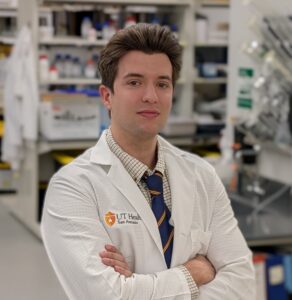
Meet Laurence Maeyens – a bioengineer from Belgium, who turned into a promising anti-aging scientist and Texan cowboy when he moved to San Antonio two years ago to pursue his doctoral degree.
Laurence, a third-year student in the Integrated Biomedical Sciences program Biology of Aging Discipline under co-mentors, Jim Nelson, PhD and Shangang Zhao, PhD, has quickly established himself as an accomplished leader and researcher and has received several prestigious awards.
Laurence was born and raised in Antwerp, Flanders, the northern, Dutch-speaking part of Belgium, a country with three official languages. Besides speaking Dutch as his native language, which allows him to understand German due to the similarities between the two, Laurence was also raised bilingually in French. During his teenage years, he passively picked up English mostly through the internet and movies, and he is currently learning Spanish as well.
During his formative years in Belgium, Laurence became fascinated with all aspects of science. At an early age, he was captivated by biology and paleontology before his interests expanded into physics and astronomy. By middle school, his passion for science grew and he had began collecting scientific instruments, fossils, stick insects, scorpions, and other small creatures. At one point, he had over 10 different species, most of which he acquired without his parents’ knowledge. In high school, he began conducting experiments using full-size ant colonies and by college, he set up his own lab at home and began filming YouTube videos. His YouTube videos demonstrate his ability to communicate complex science to diverse audiences. Give him a follow on his YouTube Channel at Talpham.
With the goal of becoming an astronaut, he completed his bachelor’s degree in Bioengineering at the University of Antwerp in Belgium, after which he pursued a master’s degree in Bioengineering specializing in Cell and Gene Biotechnology. During his master’s his plans took an unexpected turn as he became increasingly interested in the biology of aging. Laurence was intrigued by what he describes as “both the most difficult problem in biology and the one with the greatest impact if solved.” Inspired to explore aging research further, he began searching for graduate programs in this field which led him to the Barshop Institute in San Antonio.
Under the guidance of his co-mentors, Dr. Nelson and Dr. Zhao, Laurence is now addressing a longstanding mystery in aging research: why men tend to age faster and live shorter lives than women. Using genetically diverse mice that closely model the sex difference seen in humans, Laurence’s research now suggests that male sex hormones limit lifespan by negatively affecting the adipose tissue. He has several other projects, one of which involves a new “theory of aging” that he independently developed and that will soon be published, centered on the fundamental role of temperature in shaping the aging process. “I want to move beyond simply describing what changes with age and instead identify the mechanisms that determine how quickly organisms age and why. Ultimately, understanding these mechanisms may allow us to slow the aging process itself, prevent multiple age-related diseases at the same time, and help people live longer and healthier lives,” Laurence explains.
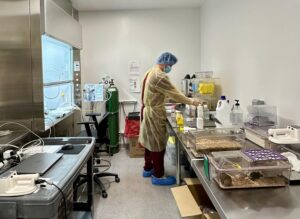
Laurence’s mentors, Dr. Nelson and Dr. Zhao, praise him for consistently demonstrating intellectual excellence, initiative, and independence. During his first year in graduate school, Laurence authored a review article that was accepted for publication in Nature Aging, the most prestigious journal in the field. Among several other co-authorships, his publications are exceptional achievements for a trainee at such an early stage. His outstanding achievements have earned him the 2026 Jess Hay Chancellor’s Fellowship ($15,000) to support his research and professional development. This summer, he used a portion of the funds for surgical supplies for a study involving 400 mice. He also plans to use the award money for a lifespan experiment that will determine, for the first time, whether testosterone is a causal factor in the shorter lifespans of males. Because this is a heavily debated topic, the results could have major implications regardless of whether testosterone is found to be the bad actor or not. Finally, this fellowship will allow Laurence to present his research at several national and international conferences.
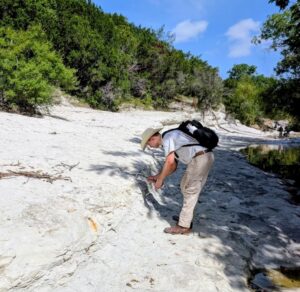
When Laurence is not conducting research, he stays busy with one of his many hobbies. He participates in blindfolded Rubik’s Cube competitions, enjoys playing chess, and was the youngest person in Belgium to earn a brown belt in Wing Revolution, a martial art that blends self-defense techniques with full contact sparring. On the weekends, Laurence trades in his lab coat for his cowboy boots. He volunteers at a local horse ranch, where he has learned to ride horses, rope, and help with various ranch activities. He loves spending time in nature and tries to get outdoors as much as possible. As a self-proclaimed outdoor enthusiast, Laurence is also a member of the Paleontological Society of Austin and goes on monthly fossil-hunting trips all around Texas and beyond.
From learning about the different fields of science as a child in Belgium to understanding the biology of aging in Texas, Laurence’s curiosity and passion for science has continued to grow. After completing his doctoral degree, he hopes to lead his own research laboratory and combine academic discovery with entrepreneurship to transform breakthroughs in aging research into real-world therapies that help people live longer, healthier lives.


